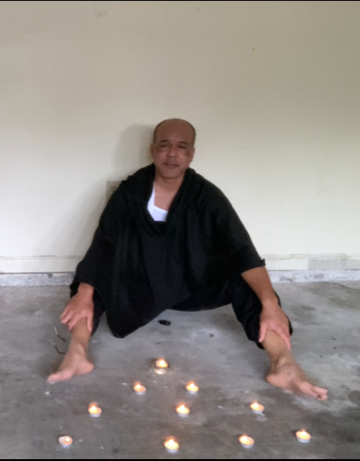
I'm three weeks in to Meisner level
one. I've found it remarkable difficult to access as an acting
discipline. It's an intuitive technique. Body awareness is a part of
it. I've practiced that many times as part of my spiritual practice
and yoga. Being open to perceiving the emotional state and energy of
your scene partner is another part that I have experience with both
in my artistic and spiritual practices.
one. I've found it remarkable difficult to access as an acting
discipline. It's an intuitive technique. Body awareness is a part of
it. I've practiced that many times as part of my spiritual practice
and yoga. Being open to perceiving the emotional state and energy of
your scene partner is another part that I have experience with both
in my artistic and spiritual practices.
And there the familiarity ends. Much of
this technique goes against all of the instincts and defenses I have
honed over the years in all aspects of life.
this technique goes against all of the instincts and defenses I have
honed over the years in all aspects of life.
Meisner technique helps you work
on being transparent in your emotions, and allowing your scene
partner perceive everything you feel since the expression of your
emotions will cause them to feel things that they will express and
allow you to perceive and feel and express and so on. Dropping the
veneer allows a dialogue to take an emotional journey between the
working actors completely independent of the words being said. Both
actors need to allow each other to see their honest emotions for it
to be effective. Trust is essential. That level of transparency and
openness of emotion is a real challenge for me.
on being transparent in your emotions, and allowing your scene
partner perceive everything you feel since the expression of your
emotions will cause them to feel things that they will express and
allow you to perceive and feel and express and so on. Dropping the
veneer allows a dialogue to take an emotional journey between the
working actors completely independent of the words being said. Both
actors need to allow each other to see their honest emotions for it
to be effective. Trust is essential. That level of transparency and
openness of emotion is a real challenge for me.
Most people maintain a control over
our emotions all the time. That's part of how we keep societies
running. So like most other people I've learned to find ways to work
with people I don't like, and create a level of impulse control so I
can be around other people. But also, I grew up in a home, at least
in my pre-teen and teen years, where the adults did not want to see
or hear my “negative” emotions. If I showed anger for example, in
action, word or even facial expression, I would be punished. If I was
anything other than happy I was expected to keep it to myself, unless
told to do otherwise. Finally, I lived much of my life in communities
where I was the only Black student in my class, or Black child in my
neighborhood. While every day was not a violent confrontation of
racial oppression with hooded Klan members. It seemed almost daily
that I was confronted with stereotypes about Black people. Most often
people looked at me and could only think of some Black person they
saw on TV. I was told I reminded people of everyone from Jimi Hendrix
to Malcolm Jamal Warner, sometimes in the same day.
our emotions all the time. That's part of how we keep societies
running. So like most other people I've learned to find ways to work
with people I don't like, and create a level of impulse control so I
can be around other people. But also, I grew up in a home, at least
in my pre-teen and teen years, where the adults did not want to see
or hear my “negative” emotions. If I showed anger for example, in
action, word or even facial expression, I would be punished. If I was
anything other than happy I was expected to keep it to myself, unless
told to do otherwise. Finally, I lived much of my life in communities
where I was the only Black student in my class, or Black child in my
neighborhood. While every day was not a violent confrontation of
racial oppression with hooded Klan members. It seemed almost daily
that I was confronted with stereotypes about Black people. Most often
people looked at me and could only think of some Black person they
saw on TV. I was told I reminded people of everyone from Jimi Hendrix
to Malcolm Jamal Warner, sometimes in the same day.
In some ways I feel I had no choice
but to become an actor. Since I felt so many people were unable to
see just me. I decided to control what they would see. I would show
them what I wanted them to see. And in studying Stanislavsky I
practiced my skill at doing that on stage and off. Intentionally
choosing to draw on sense memory to portray genuine emotion appeals
to me. It represents control, self discipline and feels powerful. It
also feels secure. I was a zealot of church of “Leave your
emotional baggage at the door”. Now, Years later, enter Meisner.
The Church of “Bring that baggage in open it up for all to see”.
It's difficult to open that bag for my scene partner. Not knowing
what they want to see, and resisting the impulse to fall back on my
habits of putting up an intentional emotional tapestry to look at,
while keeping the deeper feelings hidden is frightening. When my
scene partner looks at my face and describes to me that they see
exactly what I'm feeling I feel a torrent of emotions spurred on by
my defenses and desire to block them back out that is almost
overwhelming.
but to become an actor. Since I felt so many people were unable to
see just me. I decided to control what they would see. I would show
them what I wanted them to see. And in studying Stanislavsky I
practiced my skill at doing that on stage and off. Intentionally
choosing to draw on sense memory to portray genuine emotion appeals
to me. It represents control, self discipline and feels powerful. It
also feels secure. I was a zealot of church of “Leave your
emotional baggage at the door”. Now, Years later, enter Meisner.
The Church of “Bring that baggage in open it up for all to see”.
It's difficult to open that bag for my scene partner. Not knowing
what they want to see, and resisting the impulse to fall back on my
habits of putting up an intentional emotional tapestry to look at,
while keeping the deeper feelings hidden is frightening. When my
scene partner looks at my face and describes to me that they see
exactly what I'm feeling I feel a torrent of emotions spurred on by
my defenses and desire to block them back out that is almost
overwhelming.
It is also beginning to become very
rewarding. There is a new intensity emerging in my craft that was
never there before.
rewarding. There is a new intensity emerging in my craft that was
never there before.